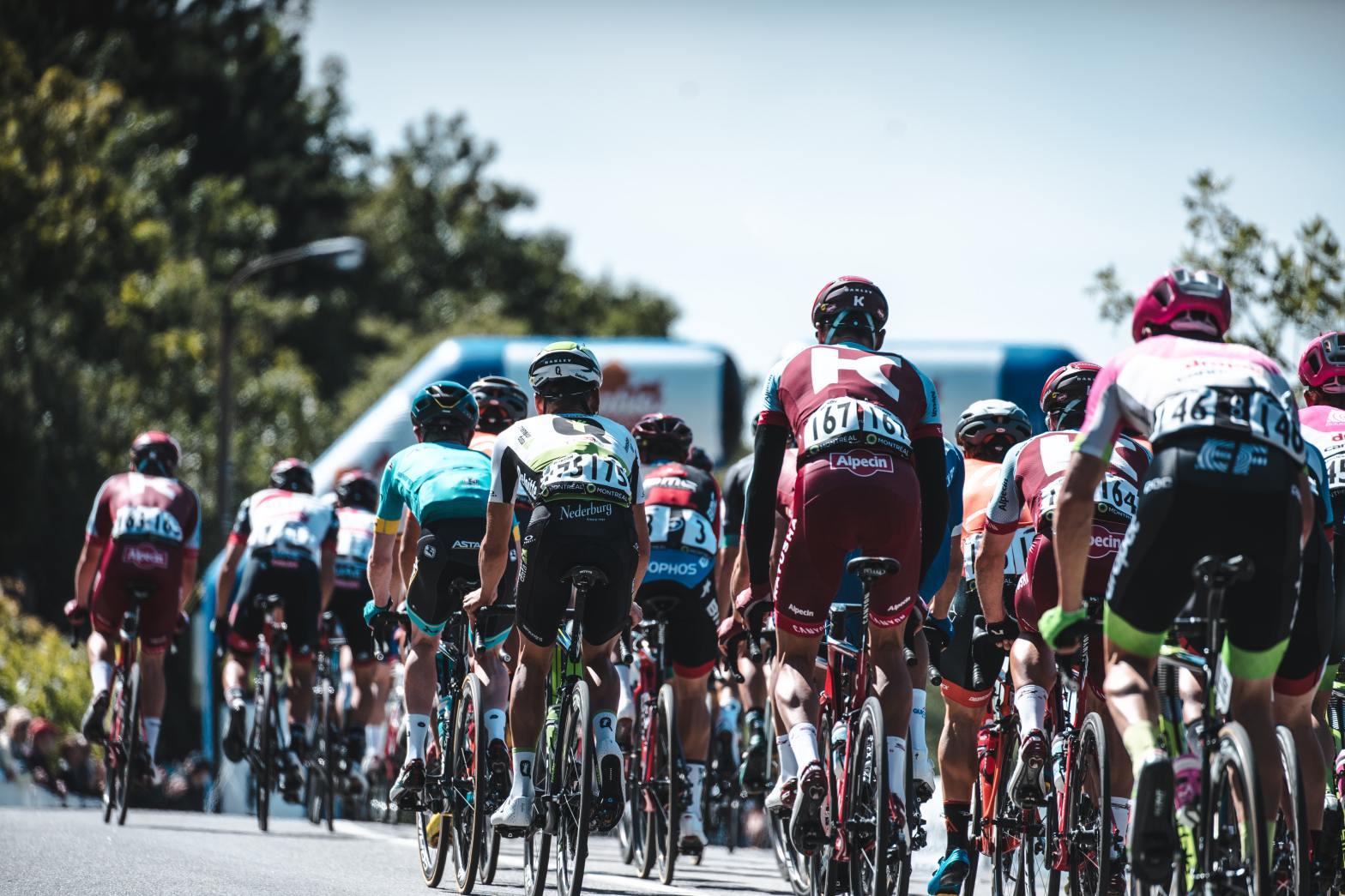
With power meters becoming evermore accessible, and the now wide-spread presence of professional cyclists on programmes such as Strava and Zwift, it is easier than ever to gain insight into the training and numbers of pro riders. The demands of professional cycling is relatively well-documented, but most research has focused on males whilst the available literature about women’s cycling remains scarce. Two retrospective studies were published in 2019 that had documented the training1 and racing2 loads of Team Sunweb’s men’s and and women’s team over 4 years, which included about 10,000 training sessions and 3,700 races. This article will present the findings from these studies and outline the similarities and differences in training and racing demands between the sexes.
A professional world tour male cyclist will ride about 30,000-35,000 km per year, and race up to 100 days. Anyone that follows pro cycling knows that the race characteristics are very different between the sexes. Men’s races can be up to 300 km, and there are multiple 21-day races (grand tours) in the the race calendar. Women will ride about 13,000-18,000 km per year; their races tend to be no longer than 160 km and the longest stage race is only 10 days long.1,2
Load and intensity can be measured in several ways. But in order to make a fair comparison between the cyclists, Training Stress Score (TSS) will be used to compare load for this article. Don’t know what it is? Here is a good explanation. As a result of shorter distances and fewer race days, the intensity in women’s races is greater, as shown by higher average heart rate (79% vs 69% of HRmax), but also that the load per km travelled (TSS*km-1) was almost 40% higher in women’s races. Despite this, the overall load remained slightly higher in men’s races. Over the course of the study, the riders had to report perceived exertion (RPE, i.e. ‘how hard was the session?’) after all sessions. Interestingly, there was no difference in RPE between men’s and women’s races, meaning that the perceived effort was the same for both race types.2
The different racing demands are highly reflected in training distribution. Unfortunately, the study did not report time spent training, therefore making it more difficult to elucidate just how much they actually train. But as mentioned earlier, male riders cover up to twice the distance of the women over a year, but this does not necessarily mean that the time spent training follows the same proportions. Much like the during the races, the women spent more time at higher relative intensities (27% higher TSS*km-1), but their training volume per session was slightly lower than the men’s (111 vs 116 TSS). It is important to note is that volume and intensity was reported per session, but whether the number of sessions differed between the sexes remains unknown. Much like during the races, there was no difference in RPE between the groups, despite the different characteristics of the training.1
But how hard do these pros actually train? In fact, the average numbers are probably not very impressive for the untrained eye. For example, the average men’s training session was about 3 hours, where ~90 km was completed at a work rate of 191 watts with an average heart rate of 66% of HRmax. The mean women’s session was 64 km, 145 minutes, and at a work rate of 138 watts with an average heart rate of 70% of HRmax.1 The reason for these low numbers lies in the extreme training volume undertaken by the cyclists; it is unsustainable to perform high volumes of high intensity training, so most of the training must be done at very low intensities.
This pattern is not exclusive for cycling and can be found throughout the world of professional endurance sport. In elite marathon running, one study found that 78% of the weekly distance was run at below marathon pace.3 Another paper that looked into the training distribution in world-class rowers, that only compete in races that take 6-7 minutes, concluded that 95% of the time spent rowing was done at low intensity.4 Even in world class swimmers that compete in distances up to 200 metres, almost 80% of training was done below the lactate threshold.5 Albeit the intensity zones were neither defined nor measured identically in the studies above, the general finding that most of the training was spent at a relatively low intensity remains relevant.
The data presented from Team Sunweb suggests that there are in fact differences in how men and women train. Even though both groups spend a high proportion training at low intensities, the women spent a relatively higher fraction at higher intensities than the men, but the overall training volume was higher for the men. This does not mean that women should train harder per se; there are a multitude of factors contributing to this result. First of all, the training distribution does reflect the race demands to a certain extent.
Maybe more importantly, men and women do face different realities as professional cyclists. In a 2019 survey amongst 324 female world tour riders,6 only 40% stated that they were full-time cyclists, the rest had part-time jobs or were studying alongside their career. Having the opportunity to be a full-time athlete will allow for more training and better recovery. Nevertheless, the overall training distribution remains similar to other sports discussed earlier. From 2020, a minimum wage of €10,000 was introduced to female world-tour cyclists that will increase annually and will by 2023 match the minimum wage of the men’s UCI professional continental teams. Whether the current disparities in training volume and intensity distributions will decrease as a result of more women becoming full-time professional cyclists remains to be seen.
References
- van Erp T, Sanders D, de Koning JJ. Training Characteristics of Male and Female Professional Road Cyclists: A 4-Year Retrospective Analysis [published online ahead of print, 2019 Nov 5]. Int J Sports Physiol Perform. 2019;1‐7. doi:10.1123/ijspp.2019-0320
- Sanders D, van Erp T, de Koning JJ. Intensity and Load Characteristics of Professional Road Cycling: Differences Between Men’s and Women’s Races. Int J Sports Physiol Perform. 2019;14(3):296‐302. doi:10.1123/ijspp.2018-0190
- Billat VL, Demarle A, Slawinski J, Paiva M, Koralsztein JP. Physical and training characteristics of top-class marathon runners. Med Sci Sports Exerc. 2001;33(12):2089‐2097. doi:10.1097/00005768-200112000-00018
- Guellich A, Seiler S, Emrich E. Training methods and intensity distribution of young world-class rowers. Int J Sports Physiol Perform. 2009;4(4):448‐460. doi:10.1123/ijspp.4.4.448
- Mujika I, Chatard JC, Busso T, Geyssant A, Barale F, Lacoste L. Effects of training on performance in competitive swimming. Can J Appl Physiol. 1995;20(4):395‐406. doi:10.1139/h95-031
- The Cyclists’ Alliance. The Cyclists’ Alliance Rider Survey 2019. The Cyclists’ Alliance website. December 23, 2019. Accessed 7 June, 2020. https://cyclistsalliance.org/2019/12/rider-survey-2019/
Photo by louis tricot on Unsplash
 THE PACE
this was a very interesting article, that was very accessible to someone who doesn’t know that much about the topic! it was also well written and easy to follow. I am looking forward to hearing more of this kind of content (provided enough research is being done on it!)