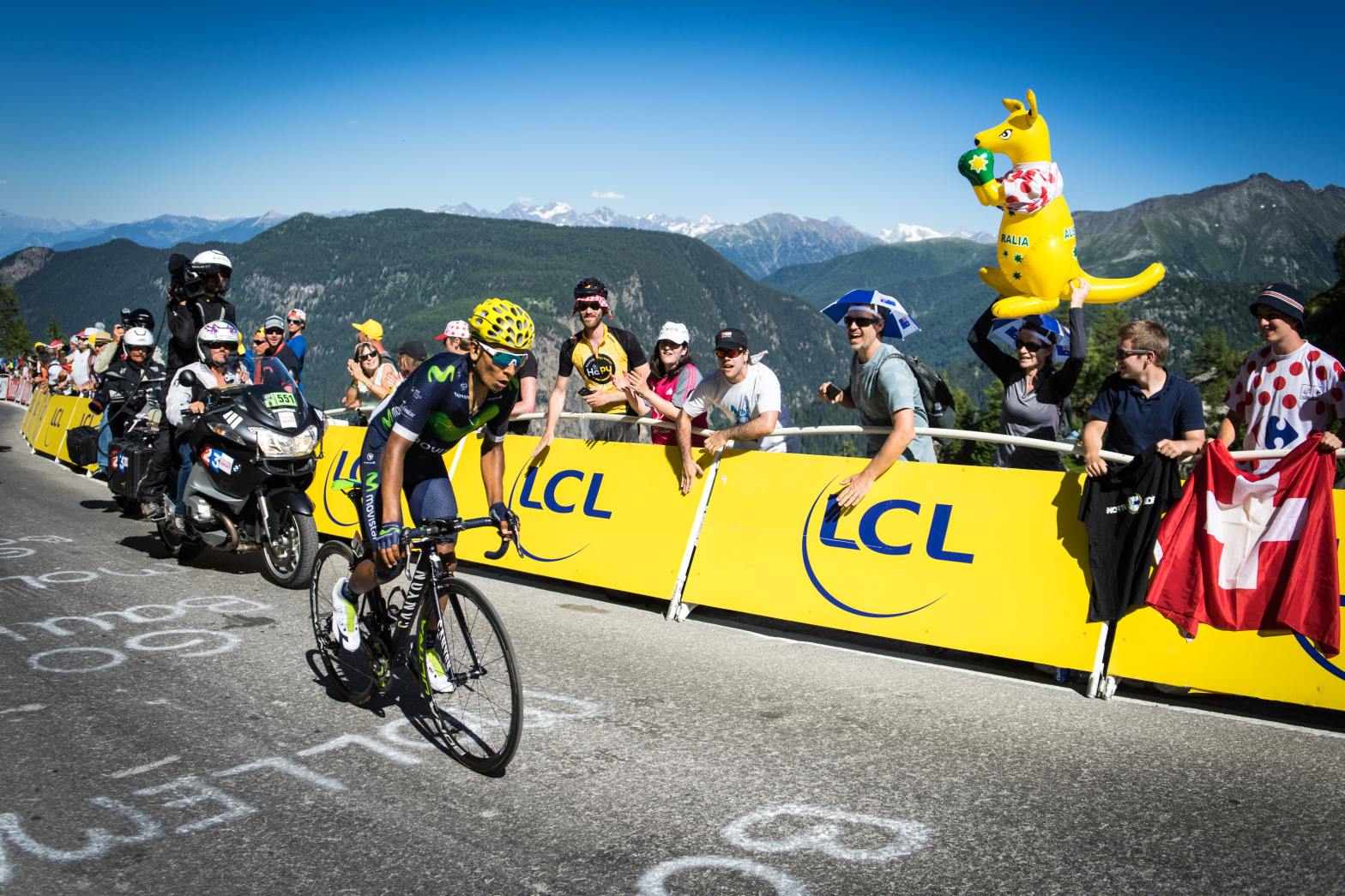
Le Tour de France. Since its’ inauguration in 1903, many people have dreamt of it, but only a handful have achieved the greatest accomplishment in the world of cycling, winning the yellow jersey. Starting off as a publicity stunt for a french newspaper featuring amateur riders, it is now the pinnacle of bike racing and possibly one of the toughest and most gruelling competitions in the world. This article will outline the demands of riding the Tour de France, and also take a deeper look into what makes a champion.
The tour has always been a long stage race taking weeks to complete, but today’s configuration of 21 stages adding up to about 3500 km almost seems like a breeze compared to the early editions of the race. In 1927, the 17 stages averaged 337 km and lasted about 14 hours each to complete.1 Concomitant to the reduction in total distance covered over the race, the average speed to complete it has increased and has in recent years been around 40 kph. Somewhat simplified, the race consists of three different stage types: flat, high-mountain, and time-trials. More information about the demands of these can be found in table 1. Over the last few decades, technological advancements such as aerodynamical components have made the tour faster without increasing the load imposed on the riders.1 Indeed, historical winners such as Eddie Merckx were able to sustain power outputs over 400 watts over an hour, much like today’s riders.2
Table 1. Stage type characteristics for a grand tour.1
| Flat stages | High mountain stages | Time-trial stages | |
| Distance (km) | ~200 | ~200 | 30-55 |
| Exercise time (h) | 4-5 | 5-6 | ≤1 |
| Mean exercise intensity | Low to moderate | Moderate to high | High |
| Mean velocity (kph) | ~45 | ~20 (during ascents) | ~50 (time-trial specialists) |
| Cycling position | Traditional (sitting) | Alternating (sitting and standing) | Aerodynamic (triathlon bars) |
| Main requirements | Technical | Physiological | Physiological and aerodynamic |
| Specific concerns | Crashes | Moderate hypoxia (altitude >1500 m) | Aerodynamics |
| Estimated mean power output | 200-250 W | ≥6 W/kg in climbers | 350 W (≥400 W in time trialists) |
The anthropometry of champions
Compared to the mid 20th century, the riders of the tour today show a greater specialisation to a certain aspect of the race. For example, time-trial (TT) specialists tend to be 180-185 cm tall and weigh 70-75 kg. The large stature allows them to generate high absolute power outputs (W). Conversely, climbers tend to be both shorter (170-175 cm) and lighter (60-66 kg) which allows them to generate high relative power outputs (W/kg). Depending on the profile of the route, different body types might have a slight advantage over others in certain years. Between 1991-2011, the winning anthropometry seemed to have been more aligned with the TT specialists’ than climbers’.1
For general classification contenders, performance at TT and mountain stages is critical as this is usually where time is gained. As previously mentioned, climbers tend to be able to produce higher relative power outputs than TT specialists, meaning that their best chance of gaining time is to excel on mountain stages. In a research paper studying the Giro d’Italia winner Tom Dumoulin over four grand tours, the authors concluded that for a TT-specialist like him, the goal is to minimise the time lost in the mountains and maximise the time gained in TT’s.3 To win a grand tour, it is necessary to be able to produce at least 6 W/kg over at least 30 minutes to be competitive in the mountains. For pure climbers, the number is probably even higher to succeed.1,3
Cardio-respiratory fitness
Maximal oxygen uptake (VO2max) is a measure of how much oxygen the body can maximally utilise, and therefore indicates the maximal level of aerobic metabolism possible. It is said to set the upper limit for human endurance performance.4 Overall, most riders in the tour have a VO2max between 70-80 mL/kg/min; climbers seem to be on the higher end of the spectrum. Altogether, having a VO2max of a least 80 mL/kg/min has been suggested to be a prerequisite to win the tour.1
Efficiency
Paramount for performance in such a long endurance event is to preserve as much energy as possible. An important component of this is gross efficiency (GE), which is the proportion between the mechanical work rate and total energy expended. In other words, a high GE results in a reduced relative intensity at a given power output. In elite cyclists, an inverse relationship has been found been VO2max and GE meaning that riders with relatively high VO2max generally have a relatively lower GE.5
Thresholds
Thresholds serve as demarcators between intensity zones. In the scientific literature, a four-zone system is generally used.6 Intensities below the lactate threshold (LT) includes all work-rates at which there is no, or a transient increase in blood lactate accumulation. This intensity can be sustained for several hours (>4 h).6 For professional cyclists, LT is usually found between 315-370 watts.1 The next intensity demarcator is called critical power (CP) and sets the upper limit for exercise intensities that does not elicit VO2max when sustained.7 Exercise between LT and CP can be sustained for up to 3-4 hours. Exercise at a work-rate resembling CP can be sustained for up to 30-45 minutes; small increments in intensity above CP result in exponential losses in time to exhaustion. The latter will result in a gradual increase in VO2 until VO2max is reached.6 Due to the inconsistency in testing methodology used to assess this “upper” threshold, it is difficult to provide a clear normal range in elite cyclists. Using ventilatory methods, it is estimated to be found between 400-450 watts.1
Over the course of a grand tour, the vast majority of the time is spend below the lactate threshold. Data from a study using heart-rate to estimate time spent on different intensities showed that 70% of the time was spent below LT.8 It is crucial for performance to be able to maintain the lowest relative intensity possible whilst still being competitive in the race to minimise fatigue for important stages or climbs, having “high” thresholds enables this.
Chris Froome: A case study of a champion
In 2017, a case study examining the physiology of professional cyclist Chris Froome was published.9 The testing was done in 2015, at which point he had won the Tour de France twice. Froome was found to have an exceptional VO2max of 84 mL/kg/min. Moreover, what makes it even more impressive is the fact that he was measured to have a GE of 23% in normal ambient conditions, and 23.6% in hot and humid conditions. To put this in perspective, in a study where VO2max and GE was tested in other world-class riders, no one with a GE >22% had a VO2max of >77 mL/kg/min. This unique combination allows Froome to sustain high power output with a minimal relative contribution from glycolytic pathways, and thus excel in grand tour racing that takes place over several weeks.
Summary
Cycling is a dynamic sport where the strongest rider does not always come out on top. Over the course of the race, the riders will experience hypoxic environments in the high mountains, and possibly extreme heat as well which are both factors that influence performance.1 This article has only touched on some of the main physiological traits of what makes a champion.
References
- Santalla A, Earnest CP, Marroyo JA, Lucia A. The Tour de France: an updated physiological review. Int J Sports Physiol Perform. 2012;7(3):200-209. doi:10.1123/ijspp.7.3.200
- Bassett DR Jr, Kyle CR, Passfield L, Broker JP, Burke ER. Comparing cycling world hour records, 1967-1996: modeling with empirical data. Med Sci Sports Exerc. 1999;31(11):1665-1676. doi:10.1097/00005768-199911000-00025
- Van Erp T, Hoozemans M, Foster C, DE Koning JJ. Case Report: Load, Intensity, and Performance Characteristics in Multiple Grand Tours. Med Sci Sports Exerc. 2020;52(4):868-875. doi:10.1249/MSS.0000000000002210
- Bassett DR Jr, Howley ET. Limiting factors for maximum oxygen uptake and determinants of endurance performance. Med Sci Sports Exerc. 2000;32(1):70-84. doi:10.1097/00005768-200001000-00012
- Lucía A, Hoyos J, Pérez M, Santalla A, Chicharro JL. Inverse relationship between VO2max and economy/efficiency in world-class cyclists. Med Sci Sports Exerc. 2002;34(12):2079-2084. doi:10.1249/01.MSS.0000039306.92778.DF
- Burnley M, Jones AM. Oxygen uptake kinetics as a determinant of sports performance. European Journal of Sport Science. 2007;7(2):63-79. doi:10.1080/17461390701456148
- Jones, A. M., Burnley, M., Black, M. I., Poole, D. C., Vanhatalo, A.. The maximal metabolic steady state: redefining the ‘gold standard’. Physiol Rep, 7 ( 10), 2019, e14098, https://doi.org/10.14814/phy2.14098
- Luciá A, Hoyos J, Carvajal A, Chicharro JL. Heart rate response to professional road cycling: the Tour de France. Int J Sports Med. 1999;20(3):167-172. doi:10.1055/s-1999-970284
- Bell PG, Furber MJ, Van Someren KA, Antón-Solanas A, Swart J. The Physiological Profile of a Multiple Tour de France Winning Cyclist. Med Sci Sports Exerc. 2017;49(1):115-123. doi:10.1249/MSS.0000000000001068
Photo by VELOBAR+ on Unsplash
Article updated on May 21st 2023.
 THE PACE
This was a fascinating read (when I read it when it was published) and it is amazing what demands are placed upon the body of a TdF rider!