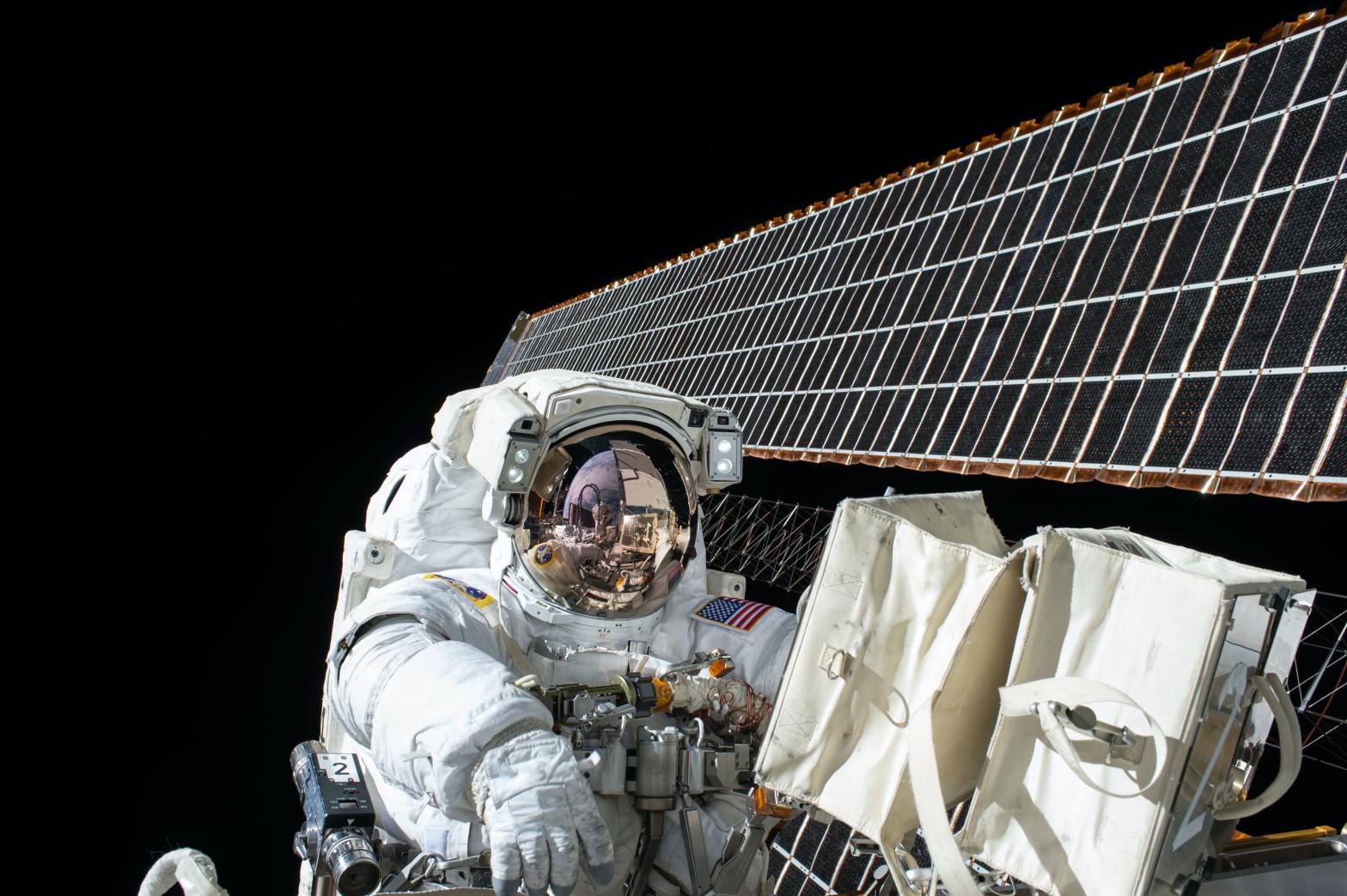
Since the beginning of space exploration, astronauts have embarked on extraordinary journeys to the most unique environments ever experienced by mankind. Despite the challenges of radiation exposure, confinement and social isolation to name a few, one aspect of spaceflight remains the most demanding: microgravity.
Here on Earth the human body has adapted to an environment with a gravitational force of 9.81m/s2 (or 1g), and several physiological processes have grown to depend on it in order to maintain homeostasis. By vacating our terrestrial planet, the force of gravity is diminished and an array of disruptions occur in the body, the most prominent being the de-conditioning of skeletal muscle, weakening of bone and atrophy of the heart.1 With an ever increasing number of astronauts being sent into space, and future missions aiming to reach destinations not yet touched by mankind, it is vital to understand the potential risks of spaceflight so that all crew members can complete their mission and return safely to Earth.1,2
The physiological challenges of microgravity
Table 1 provides you with a selection of potential tasks that crew members may need to complete at various extraterrestrial destinations as well as the physiological requirements. Notice that astronauts need to be of a certain fitness level to be able to complete the necessary tasks, particularly if they find themselves in an emergency or life-threatening situation.3 Maintaining this level of strength and endurance becomes a challenge when living in space for several months due to the fact that the catabolic nature of the microgravity environment leads to significant de-conditioning.3
| Table 1 | |||
|---|---|---|---|
| Destination | Gravitational force (g) | Potential tasks | Physiological requirements |
| International Space Station | 0 | Extravehicular activity | Muscular and cardiovascular endurance |
| Emergency exit on return to Earth (on land or water) | Power, strength and muscular endurance | ||
| Moon | 1/6 | 10km walk | Cardiovascular endurance |
| Hatch opening | Strength and power | ||
| Asteroid | Unknown | Sample retrieval | Steadiness and balance |
| Mars | 1/3 | Construction task | Strength and cardiovascular endurance |
| Ladder climb | Muscular endurance and strength |
One of the most significant decrements to the body occurs to skeletal muscle. On Earth our 1g environment enforces a load on the musculoskeletal system, but when this gravitational force is removed in space, the load is diminished and muscle atrophy occurs.2 Of particular concern are the muscles of the lower limb due to their ‘anti-gravity’ role on Earth. After 17 days of spaceflight, one study showed a 12% and 10% decrease in muscle volume of the gastrocnemius and soleus (the calf muscles), respectively.4 This effect is worsened over long-duration space missions, as shown by a reduction in gastrocnemius and soleus muscle volume of 24% and 20% respectively after crew members spent 112-196 days in spaceflight.4 What is also concerning is the fact that the loss of muscle strength appears to be more severe than the loss of muscle volume.3 After having completed 6 month Mir space missions, cosmonauts showed declines of 20-48% in maximal voluntary contraction of the calf.3 The loss of muscle strength and function could increase the risk of muscle damage when returning to a weight bearing environment, and make life on Earth particularly difficult post-mission.4
Another issue associated with the lack of gravitational loading on the musculoskeletal system is the weakening of bone. Particularly in the weight-bearing positions of the skeleton such as the hips, pelvis, neck, spine and femur, the lack of loading leads to significant reductions in bone mineral density (BMD) because the bones are not having to uphold as much weight.4 For instance, in the vertebral column BMD has been shown to decrease by as much as 11% after 7 months of spaceflight.4 The reason being is that minerals that strengthen the bone are lost via urinary excretion; calcium excretion increases by 60-70% over the first few days in microgravity.4 Again this poses significant risks when returning to Earth; if the loss of BMD is not reversed osteoporosis may occur.
Perhaps not so obvious are the changes that occur to the heart in microgravity. The absence of gravity results in large fluid redistributions across the body; fluid from the legs shifts towards the torso and the head. As a result, the contractility of the heart that is usually needed to pump blood against gravity to the head is no longer required and de-conditioning occurs.4 For example, studies have noted atrophy of the heart by 8-10% after just 10 days of spaceflight, as well as a 10% reduction in left ventricular mass.3,4 Also occurring within this time scale is a 17% reduction in plasma volume.4 This appears to translate into a compromised aerobic capacity; 14 astronauts showed a 17% reduction in VO2max after 14 days of spaceflight.3 While astronauts rarely have tasks that require maximum effort, having a reduced aerobic capacity means that the relative intensity of sub-maximal work is increased, making day-to-day activity more challenging.
This is by no means an extensive list of the physiological challenges associated with microgravity; I have chosen only to focus on the most prominent ones. Other interesting obstacles that you may enjoy to explore further include vestibular disturbances, immune function and psycho-social effects.
Countering the effects of microgravity
As mentioned previously, it is paramount to try and minimise the effects of de-conditioning on the body in order to 1) prevent long term health consequences, 2) provide optimal performance to complete the mission, and 3) safely return to Earth. NASA currently aims to prevent reductions in VO2max below 32.9ml/kg/min (a figure based on the metabolic cost of a spacewalk) and prevent strength losses of more than 20%.3 There is currently one countermeasure that is superior over any other: exercise. The goal of exercise is to provide a training stimulus that counteracts the de-conditioning of the muscle, bone and heart.
On the International Space Station (ISS), all crew members are allotted 2.5 hours a day, 6 days a week for both aerobic and resistance exercise.4 This value may be somewhat misleading because it also includes the time taken for equipment set up, reconfiguration and cleaning after the session. Once this is taken into account, only about 60 minutes of aerobic exercise is completed, along with 90 minutes of resistance training.3 Available exercise equipment on the ISS includes a treadmill, a cycle ergometer, as well as an ‘Advanced Resistive Exercise Device’ (also known as ARED). Without gravity, exercise that relies on weight as a training stimulus becomes very difficult, but the design of ARED allows astronauts to complete a range of strength exercises such as the squat, deadlift, heel raises, and bench press.3 Another factor to consider is that any vibrations from training need to be prevented in order to maintain and protect the space station structure, so treadmill speeds are limited and the cycle ergometer is fitted with a vibration isolation system.2
On arrival to the ISS, crew members complete their first exercise session no earlier than their second day, after which the time spent training and its intensity is increased over the coming weeks.2 During the mission, feedback about the exercise sessions can be sent back to Earth to be analysed by specialists and appropriate changes to training will be made.2 During the final 3-4 weeks in space, astronauts enter the ‘preparation for re-entry’ phase, and maintain high training loads with an extra focus on resistance training and treadmill running.2 Overall, one study showed that 44% of the exercise sessions completed on a mission consist of resistance training, 35% treadmill running, and 21% cycle ergometry, therefore showing a 44-56 balance in resistance versus aerobic training.2
But just how effective is it? The main consensus amongst the research is that reductions in bone mass are much easier to counteract than that of muscle and heart tissue. For example, when using a combination of the treadmill, cycle ergometer and ARED throughout 4-5 months of spaceflight, BMD in the hip and pelvis was no different to pre-flight values, whereas no such patterns have been found for muscle and the heart.4 Another paper suggests that perhaps the trend is improving, as more recent studies seem to show little or no change in BMD and cardiovascular capacity, and the decreases in muscle force production are reducing in size.2
One major downside of using exercise as a countermeasure is the amount of time that it requires. A recently published paper investigated the possibility of using high intensity interval training (HIIT) as opposed to higher volume, lower intensity aerobic sessions that are traditionally used on the ISS.1 Despite finding no differences between HIIT and standard aerobic training with regards to BMD, muscle mass, strength and function and cardiorespiratory fitness, the authors concluded it could still benefit the astronauts. Instead of their exercise protocol taking up 9 hours per week, it would only take up 6. This 33% reduction in time spent training could be incredibly valuable to crew members who have many mission-related tasks to complete.
It remains a challenge that exercise as a countermeasure is not fully effective in preventing the undesirable effects of living in a microgravity environment. This is particularly the case when considering future missions to Mars, as long transits in microgravity will be required to reach the destination. Upon arrival astronauts will need to perform physically demanding tasks, so any significant reductions in fitness could put both the mission and the astronauts at a significant risk.3
References
- English KL, Downs M, Goetchius E, et al. High intensity training during spaceflight: results from the NASA Sprint Study. NPJ Microgravity. 2020;6:21. Published 2020 Aug 18. doi:10.1038/s41526-020-00111-x
- Petersen N, Jaekel P, Rosenberger A, et al. Exercise in space: the European Space Agency approach to in-flight exercise countermeasures for long-duration missions on ISS. Extrem Physiol Med. 2016;5:9. Published 2016 Aug 2. doi:10.1186/s13728-016-0050-4
- Hackney KJ, Scott JM, Hanson AM, English KL, Downs ME, Ploutz-Snyder LL. The Astronaut-Athlete: Optimizing Human Performance in Space. J Strength Cond Res. 2015;29(12):3531-3545. doi:10.1519/JSC.0000000000001191
- Tanaka K, Nishimura N, Kawai Y. Adaptation to microgravity, deconditioning, and countermeasures. J Physiol Sci. 2017;67(2):271-281. doi:10.1007/s12576-016-0514-8
Photo by NASA on Unsplash
 THE PACE