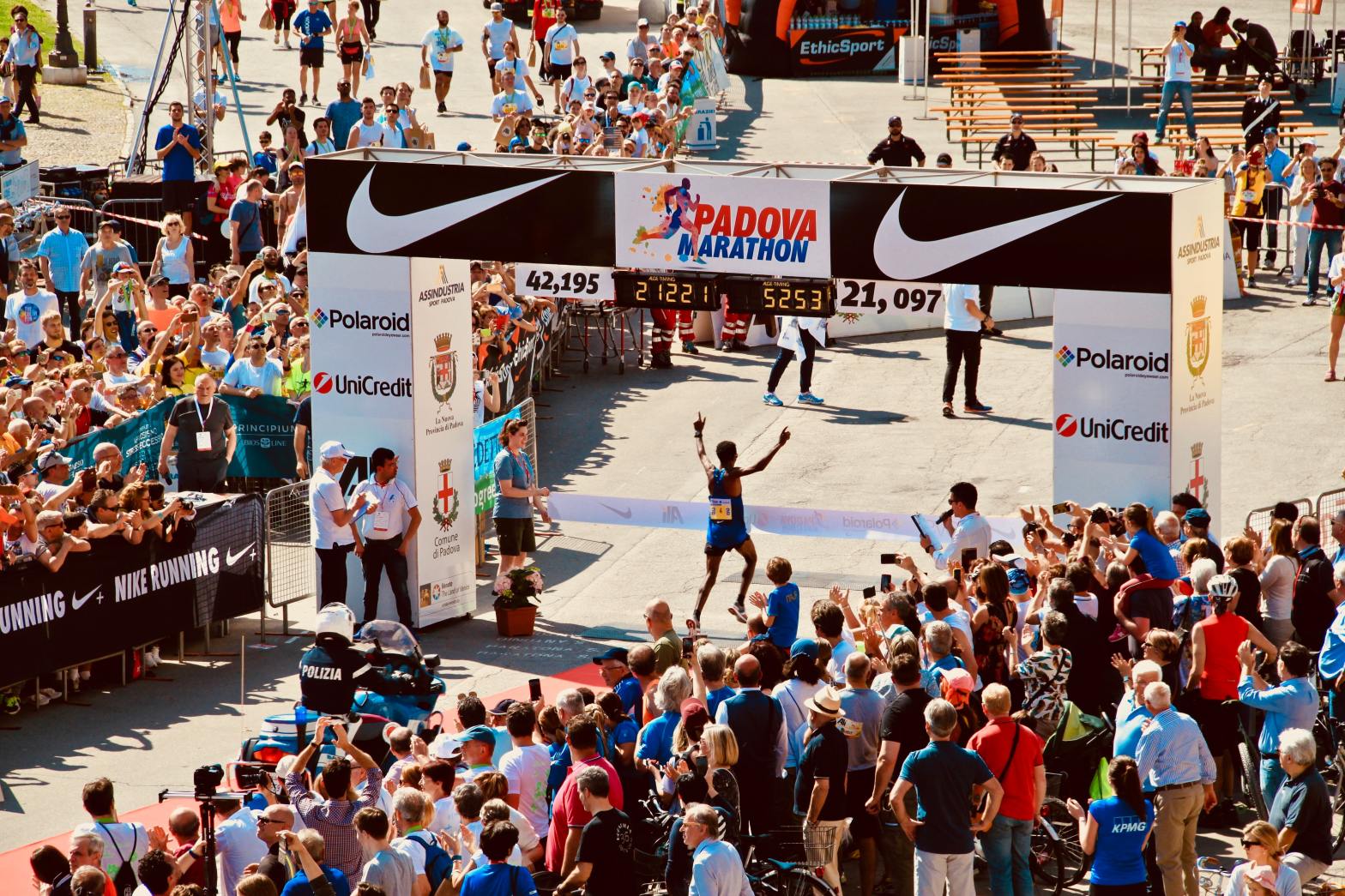
On the 12th October 2019, Eluid Kipchoge made history by becoming the first person to run a marathon in less than two hours. The Ineos 1:59 challenge saw a monumental effort to break this barrier by creating the best possible conditions for the attempt. The elements that contributed to this pioneering performance can be divided into external and internal factors. External factors can be controlled by ensuring the most advantageous profile, suitable weather conditions, and optimal pacing, drafting and nutritional strategies. More challenging to manipulate are the internal factors that determine the physiological performance of an individual.
In 2020, prominent exercise physiologist Andrew Jones set out with his research group to determine the physiological requirements of running a sub-2 hour marathon.1 To complete a marathon in under 2 hours, the runner has to be able to maintain a pace of 21km/h over 42km. This study would help to establish whether it is physiologically possible for a human to maintain this pace without influence from any recent technological innovations such as the Nike Vaporfly Next%. They noted 3 factors that impact the endurance capability of an individual (see table 1 below). The oxygen cost of running at 21km/h has not previously been measured, and it is unknown what fraction of an athlete’s VO2max would have to be sustained in order to maintain this pace.
| Factor | Description |
| VO2max | The maximum rate of oxygen uptake, i.e. how much oxygen is brought into the body and used to generate energy in the working muscles. This contributes to the aerobic capacity of an individual. |
| Fraction of VO2max that can be sustained | The percentage of VO2max that can be maintained over a prolonged period of time without fatigue leading to exercise intolerance. |
| Oxygen cost of running at marathon pace | The volume of oxygen that is required to be utilised in the body in order to carry out the motion of running at a particular pace. |
16 world-class distance runners were recruited for this study, all of which were originally selected for Nike’s Breaking 2 project. This star-studded sample included the current marathon world record holder, Eluid Kipchoge, and the 2019 world champion, Lelisa Desisa. The 16 athletes had an average best marathon time of 2:06:53. After anthropometric measurements were taken, a pulmonary function test was performed, followed by an incremental ramp test on the treadmill. This incremental test was used to gather data about heart rate, blood lactate responses, VO2 and the oxygen cost of running. Next the athletes were taken to a biomechanics laboratory, where force analysis was carried out while running at 21km/h. The final round of testing consisted of running outdoors at 21km/h on an athletics track, while the oxygen cost was measured using a portable gas analysis device.
| Measurement | Mean value |
| Height | 1.72m |
| Weight | 58.9kg |
| Maximum heart rate | 190bpm |
| VO2max | 71.0ml/kg/min |
| Oxygen cost of running at 21km/h on a treadmill | 189ml/kg/km |
| Oxygen cost of running at 21km/h on an outdoors track | 190ml/kg/km |
| First increase in blood lactate above 1-2mM (LT) | Occurred at 18.9km/h, 83% of VO2max, 166bpm |
| Sudden and sustained increase in blood lactate (LTP) | Occurred at 20.2km/h, 92% of VO2max, 181bpm |
Main findings from this analysis can be seen in table 2. For the first time, the oxygen cost of running over ground at 21km/h has been recorded. Statistical analysis found that there was no significant difference between the value measured on a treadmill and when it was measured outside on an athletics track, suggesting minimal input from wind resistance. It is important to note that 9 of the 16 athletes were unable to reach a VO2 steady state when running at 21km/h. This means that the required pace to run a sub-2 hour marathon is above their critical speed, so they are unable to maintain it without the onset of overwhelming fatigue and a significant loss of efficiency. These 9 athletes had to work at a greater proportion of their VO2max while running at 21km/h, compared to the remaining 7 athletes (97% versus 94%).
The paper was also able to predict the athletes’ highest sustainable speed, and therefore the fastest possible marathon time. To do this, they divided the highest sustainable VO2 by the oxygen cost of sub-maximal running. When the highest sustainable VO2 was assumed to be the VO2 at LT, the highest sustainable speed was calculated to be 18.7km/h. This predicts a mean best marathon time of 2:15:24, but this is notably slower than the actual mean best marathon time of 2:06:53. The authors then used the VO2 at LTP as the highest sustainable VO2. This predicted a highest sustainable speed of 20.6km/h and a mean best marathon time of 2:02:55, a value that is significantly faster than their actual mean best time. Finally, when the highest sustainable VO2 was assumed to be 96% of VO2 at LTP, the predicted mean best marathon time was 2:08:31, a value that is somewhat closer to the actual mean best time.
The authors noted that when isolated, none of the variables mentioned in table 1 were significantly associated with marathon performance. Instead, it is perhaps more suitable to consider them together. This is emphasised by the calculations above that were able to closely predict the best possible marathon performance. There are several different combinations of VO2max, oxygen cost and fractional utilisation that would allow an individual to achieve a sub-2 hour marathon. For the same oxygen cost, an individual with a large VO2max would have to sustain a smaller proportion of it compared to someone with a smaller VO2max.
To conclude, this novel study has provided fascinating insight into the limits of human physiology, while clearly demonstrating the need to consider multiple factors of endurance performance when predicting the fastest achievable marathon time.
References
- Jones AM, Kirby BS, Clark IE, Rice HM, Fulkerson E, Wylie LJ, Wilkerson DP, Vanhatalo A, Wilkins BW. Physiological demands of running at 2-hour marathon race pace. J Appl Physiol (1985). 2020 Nov 5. doi: 10.1152/japplphysiol.00647.2020. Epub ahead of print. PMID: 33151776.
Photo by Pietro Rampazzo on Unsplash
 THE PACE