
Interval training is an integral part of most serious athletes’ training regimes, but it can also be useful for those with less time to train to maintain fitness and performance. Intervals can be designed in a plethora of ways, some of which we have previously written about. This article will discuss an interesting interval training design with promising supporting scientific data.
Maximal oxygen uptake (VO2max), can be likened to the size of the athlete’s engine. Improving endurance performance is largely down to increasing one’s VO2max. Perhaps the most effective way to do so is to accumulate time at intensities near VO2max; >90% of VO2max is often used as a guideline.1 A few years back, we published an article on how manipulating the intensity during the interval or starting at a faster pace than one can sustain throughout the bout, are two effective ways of increasing the time spent near VO2max for the same level of perceived effort (RPE).
Another emerging method of increasing the time spent near VO2max is through a protocol called high-intensity decreasing interval training (HIDIT). In a 2020 study published by Vaccari et al.2 the researchers sought to maximise the time spent at >90% of VO2max through three different work-matched protocols on twelve middle-aged cyclists. The work-rate for which was calculated based on their critical power (basically functional threshold power; FTP). Resultingly, the subjects were instructed to maintain ~117% of their FTP during the intervals and ~83% of their FTP during the rest phase. The protocols were:
Short intervals (SI): Work for 30 seconds, rest for 20 seconds, and repeat until volitional fatigue.
HIDIT: Decreasing interval length in a 3:2 ratio.
- Work 3 minutes, rest 2 minutes
- Work 2 minutes, rest 80 seconds
- Work 60 seconds, rest 40 seconds
- Work 40 seconds, rest 27 seconds
- Work 30 seconds, rest 20 seconds
Repeat the last stage until volitional fatigue.
Long intervals (LI): Work for 3 minutes, rest for 2 minutes, and repeat until volitional fatigue.
A schematic of the different protocols can be seen in Figure 1 below.
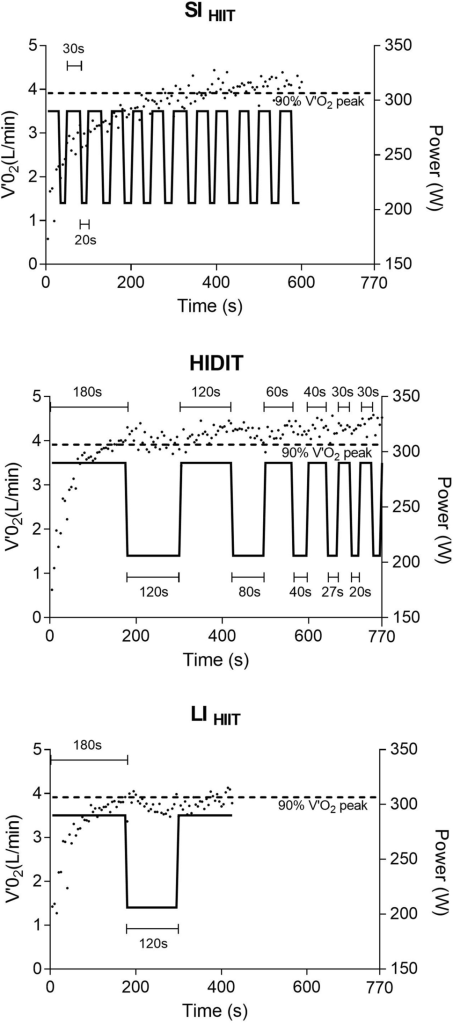
Figure 1. The three protocols for a representative subject. Dots represent VO2 and dashed lines represent the 90% of VO2max threshold. Adopted from Vaccari et al. (2022)2 (CC BY 4.0).
Results
The principal finding was that the HIDIT protocol almost doubled the time spent at >90% of VO2max compared to SI and LI (Figure 2). The oxygen uptake curves (black dots) can be seen in Figure 1. After 3 minutes, the average person in the HIDIT and LI condition had reached the desired threshold, whereas the SI condition was still at ~85% of VO2max. The SI condition rated their perceived exertion (on a scale from 1-10) ~5.5, and HIDIT and LI ~6.5. Whilst there was no statistically significant difference in how long the subjects lasted in each condition, it is worth noting that it did differ by quite some margin, SI: 714 ± 265 seconds, HIDIT 798 ± 185 seconds, LI 664 ± 282 seconds. At completion, the RPE, heart rate, VO2, and lactate levels were indifferent between all conditions.
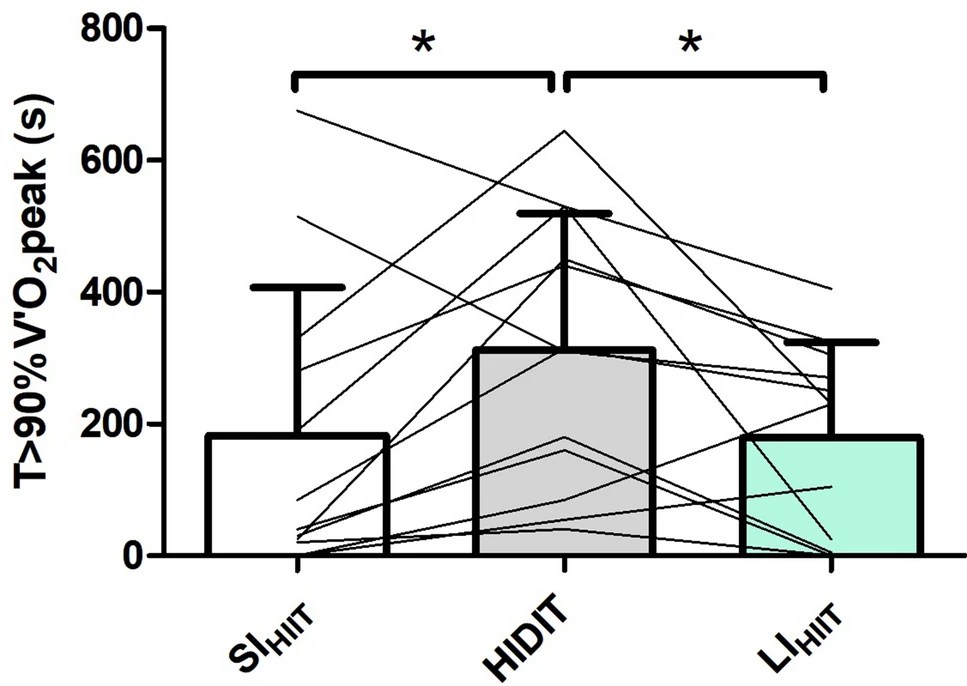
Figure 2. The time spent above 90% of VO2max in seconds. Adopted from Vaccari et al. (2022)2 (CC BY 4.0).
Practical implications
These data suggest that the HIDIT protocol could potentially elicit greater performance gains than the other two types of intervals for the same time spent training and perceived fatigue. To the best of my knowledge, there is no study to date looking at the effects of a HIDIT-type protocol compared to traditional intervals over time. Similar protocols (such as the 30/15s intervals) that also increase the time spent >90% of VO2max have resulted in superior performance gains over more traditional interval types.3,4
In a practical sense, when I prescribe these types of intervals to the athletes that I am working with, I instruct them to do 2-3 blocks of about 12 minutes of each HIDIT block, that is, all the way down to the 30/20 intervals (see Figure 1) and do one or two of those. The precise nature of the exercise description depends on the athlete’s fitness, freshness, and phase of training. Nevertheless, the total session duration would end up being around 1 hour, where about half of the time is spent working above their FTP and ~10-15 minutes is spent at an intensity of >90% of VO2max.
During the work phase, the power output (or speed if you are running) should be the maximum that you can sustain for about 5 minutes. This would be around 117% of your FTP. The rest phase should not be complete rest. If you are using power, it should be the same delta as the work intervals from the FTP. That is, 83% of your FTP. If you don’t have access to power, then rest at a pace slightly below that which you can sustain for almost an hour.
Summary
HIDIT type intervals are a good alternative to more traditional intervals for those seeking to maximise the time spent near VO2max!
References
- Buchheit M, Laursen PB. High-Intensity Interval Training, Solutions to the Programming Puzzle. Sports Med. 2013;43(5):313-338. doi:10.1007/s40279-013-0029-x
- Vaccari F, Giovanelli N, Lazzer S. High-intensity decreasing interval training (HIDIT) increases time above 90% VO2peak. Eur J Appl Physiol. 2020;120(11):2397-2405. doi:10.1007/s00421-020-04463-w
- Rønnestad BR, Hansen J, Nygaard H, Lundby C. Superior performance improvements in elite cyclists following short-interval vs effort-matched long-interval training. Scandinavian Journal of Medicine & Science in Sports. 2020;30(5):849-857. doi:10.1111/sms.13627
- Bossi AH, Mesquida C, Passfield L, Rønnestad BR, Hopker JG. Optimizing Interval Training Through Power-Output Variation Within the Work Intervals. International Journal of Sports Physiology and Performance. 2020;15(7):982-989. doi:10.1123/ijspp.2019-0260
Photo by Angel Santos on Unsplash.
 THE PACE