Not only was Marcel Kittel notorious for having the best hair in the peloton during his pro-cycling career, but he was also a formidable sprinter with an impressive 19 grand tour stage wins to his name. After ending his debut season with 17 race wins, his sprinting success continued to flourish throughout his career all the way to his retirement in 2019, after collecting an astounding 89 race wins. But how did he do it?
Luckily for us, Kittel recently teamed up with 2 sports scientists to analyse his performances at the Tour de France all the way from 2013 to 2017. Together they produced two research papers, the first investigating the demands of riding the Tour de France as a sprinter.1 This article is going to focus on the second paper which describes the sprinting tactics adopted by the two teams he raced for throughout this period: Shimano (2013 to 2015) and Quickstep (2016 to 2017).2 By the end of this article, you should be ready to smash the next club ride sprint!
The Study
Twenty-one stages in which Kittel contested for the sprint victory were analysed over 4 editions (2013, 2014, 2016, 2017) of Le Tour de France. Each sprint was categorised as won or lost and as the team he was riding for. Performance characteristics were measured using power meter data and video footage from the race. A summary of the outcome variables is outlined in the table below:
| Performance Characteristic | Description |
| Maximal mean power output | Taken from multiple durations (5s, 10s, and 15s) over the last 20s of sprint. |
| Duration of sprint | Taken from the initiation of Kittel’s sprint until he crossed the finish line. |
| Position in peloton | Taken at 10, 5, 3, 2, 1.5, 1, 0.5, and 0.25 minutes from the finish line. |
| Number of supporting teammates | Taken at 10, 5, 3, 2, 1.5, 1, 0.5 and 0.25 minutes from the finish line. |
| Mean power output | Taken at intervals: 10-5, 5-3, 3-2, 2-1.5, 1.5-1, 1-0.5, 0.5-0.25, and 0.25-0 minutes from the finish line. |
Kittel’s Sprint Statistics
Of the 21 sprint finishes, Kittel managed to win a whopping 67%! The sprints lasted between 7 and 17s, with an average speed of 65.5km/h and a mean cadence of 112 rpm. Kittel’s average mean power output was 1411 watts, and the highest recorded 5s power output was an astonishing 1813 watts, a value which overlaps that of elite track cyclists who typically produce greater power than road cyclists.3 The authors note that Kittel’s power outputs across these stages are the highest ever published in road racing, solidifying his reputation as one of the greats. Compared to a previous analysis of sprint performance in professional road cyclists,4 Kittel’s mean power output was more than 200 watts greater. Interestingly, the difference between peak power output and mean power output in the sprint was the same in both studies, suggesting that Kittel’s advantage originates from greater power production as opposed to his ability to maintain a high power output.
Shimano vs. Quickstep
This study also uncovered some intriguing differences in the sprint tactics adopted by two teams he rode for, Shimano and Quickstep. Kittel won 80% of sprints at Le Tour de France when he rode for Shimano, compared to ‘just’ 55% with Quickstep. With Shimano, Kittel had a greater number of teammates supporting him at 3, 2, 1.5, and 0.25 minutes from the finish. He was also significantly closer to the front of the race at 10, 3, 2, 1.5, 1, 0.5, and 0.25 minutes to go. It, therefore, makes sense that mean power output was significantly greater with Shimano during earlier intervals of the sprint (10-5, 3-2, and 1.5-1 minutes), but higher with Quickstep at 0.5-0.25 minutes from the finish.
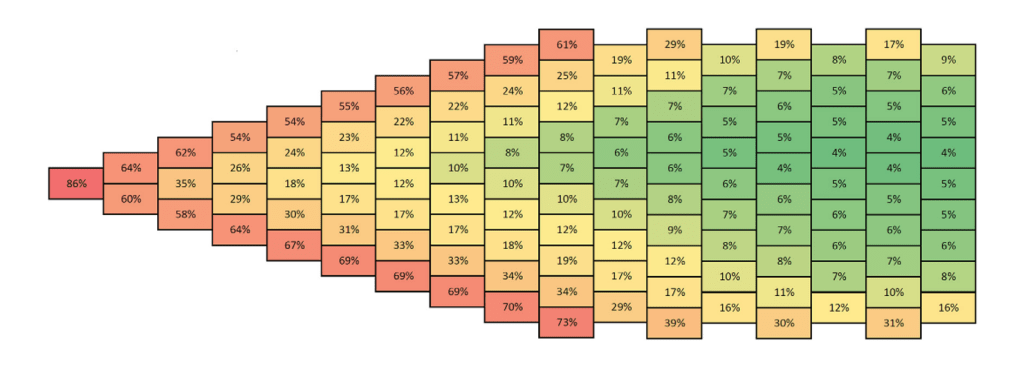
It becomes apparent that sprint tactics at Shimano involved riding at the front of the peloton for the final 3km in a sprint train formation. This means that Kittel was in a good position to launch the sprint, but he would have been more exposed to wind resistance and therefore forced to utilise valuable energy (see Figure 1 below).5 On the other hand, Quickstep tended to be further back in the peloton in the sprint build-up, and only move to the front with ~30 seconds to go. As a result, Kittel was able to draft in the peloton for longer before putting in a larger surge of power to reach the front. While Quickstep’s strategy is significantly more effective for conserving energy via drafting, there is a significant risk of being either boxed in or held up by a crash.
Wins vs. Losses
When comparing the sprints that Kittel lost and won, there were no differences in many sprint characteristics, including power output, cadence, speed and sprint duration. However, he was significantly further from the front at 30 seconds to go in the sprints he lost, perhaps explaining the lower success ratio when riding for Quickstep.
Summary
There is no doubt that Marcel Kittel is one of the greatest sprinters of all time, consistently winning 16-22% of road races he started in 2012, 2013, 2014, 2016, and 2017. This insightful paper has demonstrated large variations in sprint tactics and power outputs between professional cycling teams, potentially contributing to their Tour de France success rate. Overall it seems that race position at 30 seconds to go is the greatest determinant of success, and while very few of us will ever get to experience a victory like Kittel, it might just give you the edge in your next lamppost sprint!
References
- van Erp T, Kittel M, Lamberts RP. Demands of the Tour de France: A Case Study of a World-Class Sprinter (Part I). Int J Sports Physiol Perform. 2021;16(9):1363-1370. doi:10.1123/ijspp.2020-0700
- . van Erp T, Kittel M, Lamberts RP. Sprint Tactics in the Tour de France: A Case Study of a World-Class Sprinter (Part II). Int J Sports Physiol Perform. 2021;16(9):1371-1377. doi:10.1123/ijspp.2020-0701
- Gardner AS, Martin JC, Martin DT, Barras M, Jenkins DG. Maximal torque- and power-pedaling rate relationships for elite sprint cyclists in laboratory and field tests. Eur J Appl Physiol. 2007;101(3):287-292. doi:10.1007/s00421-007-0498-4
- Menaspà P, Quod M, Martin DT, Peiffer JJ, Abbiss CR. Physical Demands of Sprinting in Professional Road Cycling. Int J Sports Med. 2015;36(13):1058-1062. doi:10.1055/s-0035-1554697
- Blocken B, van Druenen T, Toparlar Y, Malizia F, Mannion P, Andrianne T, Marchal T, Maas GT, and Diepens J. Aerodynamic drag in cycling pelotons: New insights by CFD simulation and wind tunnel testing. Journal of wind engineering & industrial aerodynamics. 2018; 179: 319-337. doi:10.1016/j.jweia.2018.06.011
Photo by Howard Bouchevereau on Unsplash.
 THE PACE