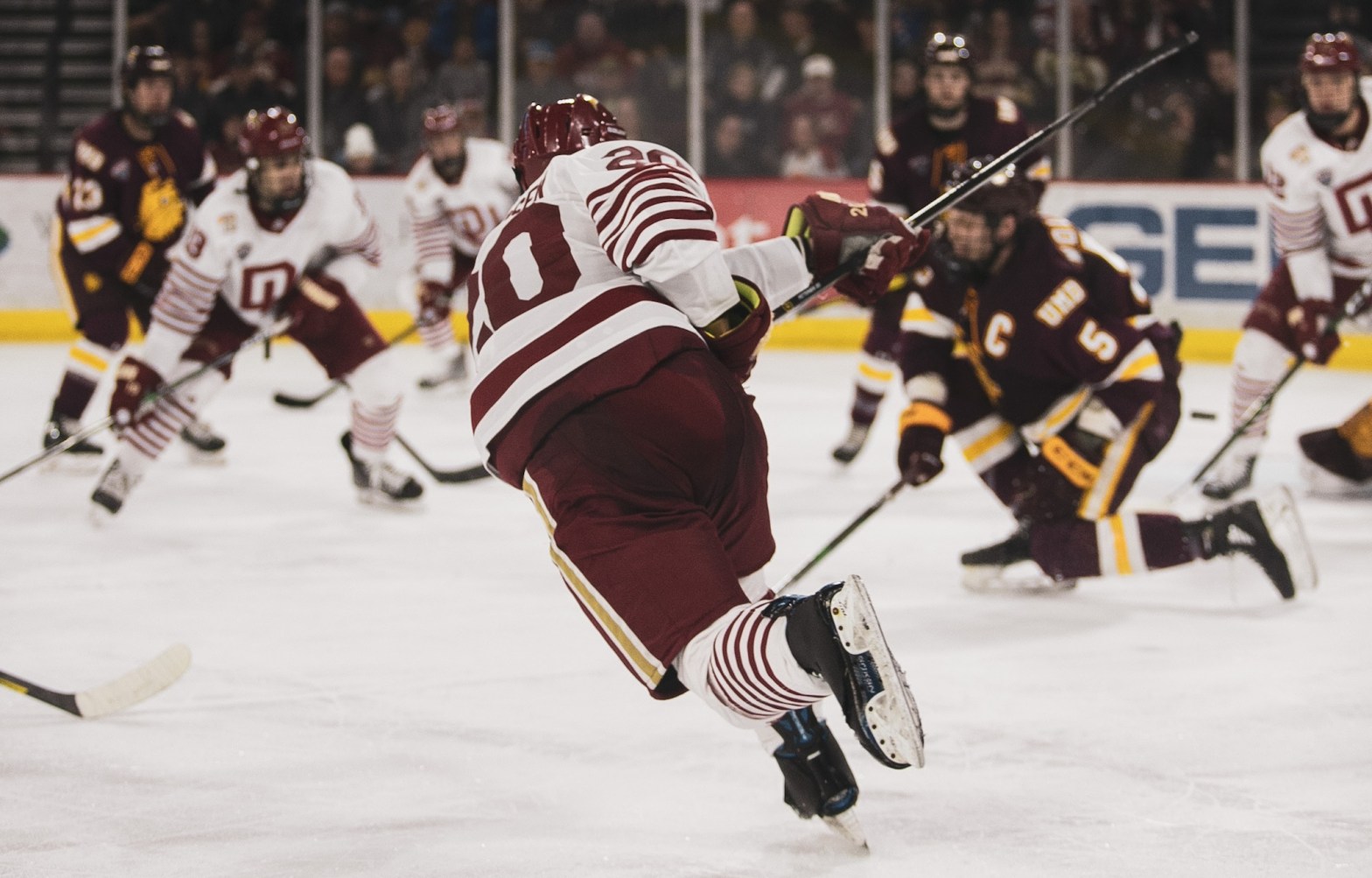

In the dynamic world of professional ice hockey, the morning skate stands as a testament to the sport’s evolution. With about 80 years of history, this once-pragmatic session has transformed into a coach-driven, multi-faceted practice shaping the pre-game preparations of players. Yet, with changing coaching philosophies and a more nuanced understanding of player needs, the morning skate finds itself at a crossroads. This article delves into the historical narrative and explores the scientific underpinnings, shedding light on its role in the quest for peak player performance.
The evolution of the morning skate
The morning skate, a preparatory training session undertaken a few hours before a competitive evening game. Nowadays largely being a coach-driven activity, the origins of the morning skate dates back to the 1940s Toronto Maple Leafs.1 At the time, the team struggled to get their ice skates in perfect condition. Therefore, the players introduced a pre-game equipment testing session, to ensure that their skates were sharp and game-ready.1 Over the years, the purpose of the morning skate changed and some coaches implemented them thereafter to prevent players from excessively drinking the night before games.
“If you knew you had to be at the rink in the morning and there was a coach you had to answer to, yeah it would certainly make you think twice before partying all night and having booze on your breath the next day”
-Darryl Sittler, NHL Hall of Famer2
The morning skate was widely popularised in the 1970s when implemented by the Soviet Red Army team in 1972 and subsequently employed by the Stanley Cup-winning Philadelphia Flyers in 1974 and 1975.3 Ever since, the morning skate has become something of a ritual for most players. In the last few years, however, the use of mandatory morning practice has been abandoned by some coaches owing to the perceived benefits of increased rest and energy saving leading up to the game.1 So what does the science say about the potential benefits of the morning skate?
The science behind the morning skate
Former Colorado Avalanche goalkeeper Patrick Roy talked to his posts during the games and thanked them for deflecting the pucks after being hit.4 Such bizarre behaviours are not uncommon amongst sportspeople, where about 80% of elite athletes employ some seemingly irrational superstitious behaviour.5
“Superstitious rituals are defined as unusual, repetitive, rigid behavior that is perceived to have a positive effect by the actor, whereas in reality there is no causal link between the behavior and the outcome of an event”
-Womack (1992)6, via Schippers and Van Lange (2006)5
Superstitions should not be confused with pre-game preparations. The former controls the athlete and has no real impact (other than a placebo) on the performance, whereas the latter is controlled by the athlete and aids readiness.4 Superstitious behaviours tend to arise as a means to mediate control over stressful situations. It has been found that the relative importance of superstitions increases when facing tougher challenges, such as playing better opponents, in an attempt to regulate anxiety.5
How these superstitions may arise varies, but it is often the result of trying to recreate the circumstances of a previous success. A classic study by Skinner (1948) showed that pigeons fed at random tried to recreate the circumstances and behaviours that occurred when they obtained food.7 Hence, a perceived causal effect of their behaviours on food acquisition was formed, even though the events were completely unrelated.
For many players now, the morning skate may just be a routine, habit, or part of superstitious behaviour. A tick-box that must be checked to maximise the perceived optimal preparation prior to the game. Much like for the 1940’s Toronto Maple Leafs, it might just give that extra sense of control to the athlete.
Physiological aspects
After measuring the training load of the AHL team Laval Rocket over 76 games of the 2017-2018 season, Allard et al. found that the morning skates imposed training loads equivalent to 34% of a game. Over the season, they conducted 35 morning skate sessions, which in total added up to a training load equivalence of 12 additional games (!) which is a meaningful increase in training load, as they averaged almost 3 games per week already.8 Load management is particularly relevant given the cumulative fatigue that arises during the season resulting in impaired neuromuscular performance during the late phases of the year.9
Post-activation potentiation (PAP) is a common aspect of a warm-up protocol. By briefly exposing the body to sport-specific movement at a high intensity, such as short sprints during the morning skate, the nervous system and working muscles increase their power generation ability and overall function, which would subsequently improve skating performance.10,11,12 Successful implementation of PAP interventions require a positive balance between performance enhancements and accumulated fatigue. For instance, weighted one-ice sprints improved normal sprints 4 minutes later, likely via this precise mechanism.12 Given that PAP only lasts for <20 minutes, this would be ineffective for evening performance.11
In other studies researching professional athletes, such as in Rugby Union, more general morning conditioning including either gym-based strength training, sprints, or cycling sprints has proven beneficial on measures of afternoon performance.13,14 Further, in a recent review including subjects that were mostly not elite athletes, it was found that morning resistance low volume, moderate-to-high intensity training had positive effects on subsequent strength, power, and speed, all attributes crucial for ice-hockey performance. They suggested implementing 3 sets of 3-4 repetitions using loads >80% of 1RM, 4-6 hours prior to competition.15 The reviewers also found that short (<30 seconds) maximal sprints 5-6 hours before competition improved sprint times and repeated sprint ability, also relevant for hockey performance.15
None of the aforementioned interventions have been assessed in an ice-hockey specific setting, but it is prudent to surmise that for the morning skate to have measurable physiological benefits on game-day performance, low-volume, and high-intensity sessions should probably be favoured. One could of course argue that the morning skate also gives the athlete an opportunity to mentally or technically prepare for the subsequent game, which is anecdotally often referenced when asking players about their rationale for attending morning skates.
Other considerations
So far, we have looked at the morning skate in the light of elite ice hockey performance, where winning is the sole objective. Broadening the perspective, this might not always be the case. Whilst not applicable to NHL franchises, most European ice-hockey clubs have junior academies with players typically aged 15-20 with the ultimate goal of developing the best senior players. This means that training is often prioritised over winning, and the ensuing residual fatigue might hamper acute performance. In this scenario, the morning skate could be seen as another training opportunity where tactical and technical aspects of the game can be practised in a similar manner to any other training session, even though the players might be more fatigued for the subsequent game.
Summary
Sleep and recovery are pillars of development and performance. In a sample of collegiate basketball players, a sleep extension intervention improved several indices of performance and well-being.16 Being a “morning” or “evening” person would certainly influence one’s perception of early practice. In the case of evening people, allowing for extended sleep and recovery should be considered to enable them to perform optimally later in the day.
Optimising overall player and team performance is complex with respect to morning skates. A one-size-fits-all approach might not be appropriate for a multitude of reasons. Players low on ice time and healthy scratches will probably benefit from additional training, whereas players with high ice time may accumulate unnecessary levels of fatigue. Veteran players may see the morning skate as an essential game day routine (superstitious or not), whereas more inexperienced players are more malleable. Perhaps most importantly, unless there is a clear perceived benefit for the team to schedule mandatory morning skates, giving the athletes the autonomy to decide what their preparations will likely improve well-being and ensure optimal performance.17
Brocherie and Perez (2023)3 list the following factors to consider for optimal game-day preparation strategies:
- Competition calendar and density of schedule
- Previous days (training or not, travel or not) and game time
- Players’ chronotype, habits, and preferences
- Individual on-ice playing time/workload (e.g., low vs. high playing time players) and status (fatigued, injured)
- Technical staff needs (e.g., opponent-specific tactical preparation)
- Off-ice alternatives [e.g., meetings, video sessions, resistance or (resisted) sprinting exercise]
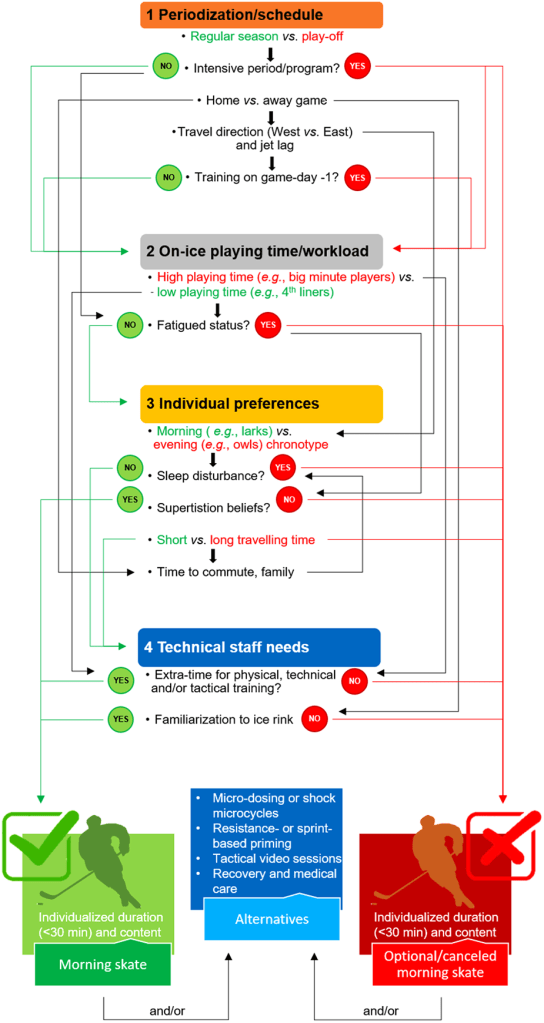
Figure 1. “Decision tree for the implementation of morning skate. Green text and arrows refer to a positive weight (or effect); red text and arrows refer to a negative weight (or effect); black arrows branch off into other possible factors.” Adopted from Brocherie and Perez (2023).3 (CC BY 4.0).
References
- McGran K. The morning skate is on its way out of the NHL. Toronto Star. Published December 6, 2015. Accessed November 11, 2023. https://www.thestar.com/sports/leafs/the-morning-skate-is-on-its-way-out-of-the-nhl/article_46c216b0-1c1c-53da-a531-742b614e5488.html
- Traikos M. Is the morning skate an outdated NHL ritual? One coach has killed it, but not everyone agrees. nationalpost. Published February 10, 2017. Accessed November 11, 2023. https://nationalpost.com/sports/hockey/nhl/is-the-morning-skate-an-outdated-nhl-ritual-one-coach-has-killed-it-but-not-everyone-agrees
- Brocherie F, Perez J. Debunking the myth of morning skate on game day. Front Sports Act Living. 2023;5. Accessed November 11, 2023. https://www.frontiersin.org/articles/10.3389/fspor.2023.1284613
- Dömötör Z, Ruíz-Barquín R, Szabo A. Superstitious behavior in sport: A literature review. Scand J Psychol. 2016;57(4):368-382. doi:10.1111/sjop.12301
- Schippers MC, Van Lange PAM. The Psychological Benefits of Superstitious Rituals in Top Sport: A Study Among Top Sportspersons1. J Appl Soc Psychol. 2006;36(10):2532-2553. doi:10.1111/j.0021-9029.2006.00116.x
- Womack M. Why athletes need ritual: A study of magic among professional athletes. Sport Relig. Published online 1992:191-202.
- Skinner BF. Superstition in the pigeon. J Exp Psychol. 1948;38(2):168-172. doi:10.1037/h0055873
- Allard P, Martinez R, Deguire S, Tremblay J. In-Season Session Training Load Relative to Match Load in Professional Ice Hockey. J Strength Cond Res. 2022;36(2):486. doi:10.1519/JSC.0000000000003490
- Gannon EA, Higham DG, Gardner BW, Nan N, Zhao J, Bisson LJ. Changes in Neuromuscular Status Across a Season of Professional Men’s Ice Hockey. J Strength Cond Res. 2021;35(5):1338. doi:10.1519/JSC.0000000000004001
- Afonso J, Brito J, Abade E, et al. Revisiting the “Whys” and “Hows” of the Warm-Up: Are We Asking the Right Questions? Sports Med Auckl NZ. Published online September 2, 2023. doi:10.1007/s40279-023-01908-y
- McGowan CJ, Pyne DB, Thompson KG, Rattray B. Warm-Up Strategies for Sport and Exercise: Mechanisms and Applications. Sports Med. 2015;45(11):1523-1546. doi:10.1007/s40279-015-0376-x
- Matthews MJ, Comfort P, Crebin R. Complex Training in Ice Hockey: The Effects of a Heavy Resisted Sprint on Subsequent Ice-Hockey Sprint Performance. J Strength Cond Res. 2010;24(11):2883. doi:10.1519/JSC.0b013e3181e7253c
- Russell M, King A, Bracken RM, Cook CJ, Giroud T, Kilduff LP. A Comparison of Different Modes of Morning Priming Exercise on Afternoon Performance. Int J Sports Physiol Perform. 2016;11(6):763-767. doi:10.1123/ijspp.2015-0508
- Cook CJ, Kilduff LP, Crewther BT, Beaven M, West DJ. Morning based strength training improves afternoon physical performance in rugby union players. J Sci Med Sport. 2014;17(3):317-321. doi:10.1016/j.jsams.2013.04.016
- Mason B, McKune A, Pumpa K, Ball N. The Use of Acute Exercise Interventions as Game Day Priming Strategies to Improve Physical Performance and Athlete Readiness in Team-Sport Athletes: A Systematic Review. Sports Med. 2020;50(11):1943-1962. doi:10.1007/s40279-020-01329-1
- Mah CD, Mah KE, Kezirian EJ, Dement WC. The Effects of Sleep Extension on the Athletic Performance of Collegiate Basketball Players. Sleep. 2011;34(7):943-950. doi:10.5665/SLEEP.1132
- Purcell R, Pilkington V, Carberry S, et al. An Evidence-Informed Framework to Promote Mental Wellbeing in Elite Sport. Front Psychol. 2022;13. Accessed November 11, 2023. https://www.frontiersin.org/articles/10.3389/fpsyg.2022.780359
Photo by LOGAN WEAVER | @LGNWVR on Unsplash
 THE PACE